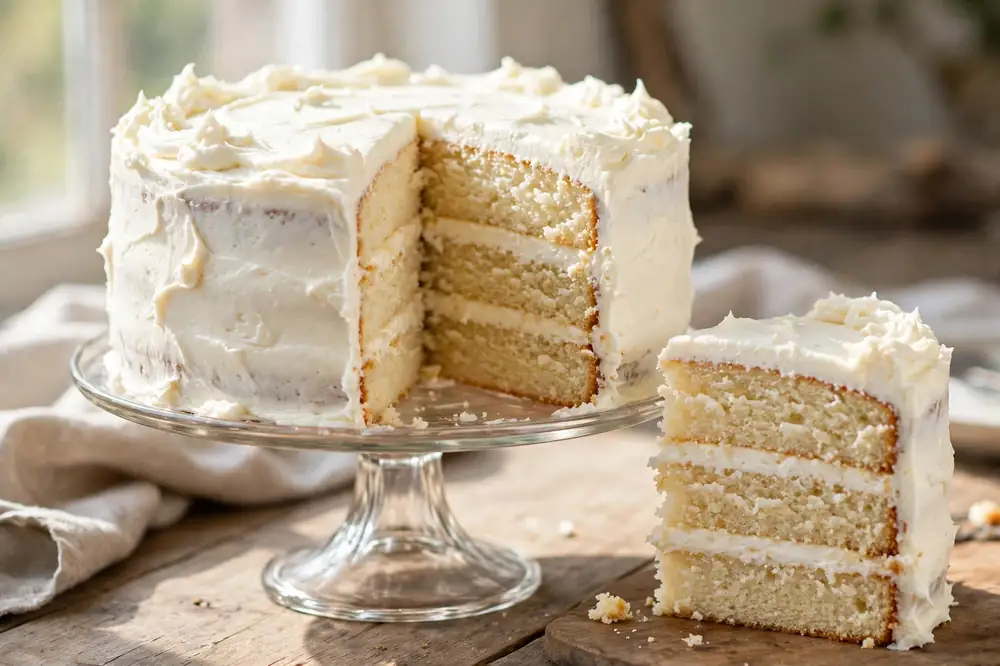
A good vanilla cake is harder to make than a good chocolate cake, because there is nothing to hide behind. No cocoa, no strong spices, no chocolate chips. The flavor comes from butter, sugar, eggs, and real vanilla, and the texture has to be soft, moist, and tender on its own. When it works, it is the cake everyone asks for at birthdays, and it is the base for almost every celebration cake you will ever bake.
The secret to a moist vanilla cake is a combination of butter and oil. Butter gives flavor. Oil keeps the cake moist for days, even after it has been refrigerated. Sour cream adds tenderness and a gentle tang that balances the sweetness. And cake flour, if you have it, gives a finer, softer crumb than all-purpose flour.
This recipe makes two 8-inch layers or one 9 by 13-inch sheet cake. It rises evenly, it does not dome too much, and it is sturdy enough to frost and stack but soft enough to cut with a fork. Frost it with vanilla buttercream for a classic birthday cake, or serve it plain with fresh berries and whipped cream. Either way, start with room temperature ingredients, do not overmix the batter, and you will have a cake worth making from scratch.
Why You Will Love This Recipe
Here is what makes this vanilla cake different from a box mix.
- Stays moist for days. The butter and oil combination keeps the crumb soft long after baking, even in the refrigerator.
- Real vanilla flavor. Two teaspoons of pure vanilla extract, plus vanilla in the frosting, give a warm, floral flavor that imitation vanilla cannot match.
- Even, level layers. The batter is balanced so the layers rise flat, which makes frosting and stacking much easier.
- Versatile base. Use it for birthday cake, cupcakes, a trifle, or a sheet cake with fruit and whipped cream.
- Freezes beautifully. Wrap cooled layers tightly and freeze for up to 2 months for a make-ahead celebration cake.
Ingredients
If you do not have cake flour, you can make a substitute: for each cup of cake flour, measure 1 cup of all-purpose flour, remove 2 tablespoons, and replace them with 2 tablespoons of cornstarch. Sift it together before using.
- 2 1/2 cups cake flour
- 2 teaspoons baking powder
- 1/2 teaspoon baking soda
- 1/2 teaspoon salt
- 1/2 cup (1 stick) unsalted butter, softened
- 1/2 cup vegetable oil
- 1 3/4 cups granulated sugar
- 4 large eggs, at room temperature
- 2 teaspoons pure vanilla extract
- 1 cup full-fat sour cream, at room temperature
- 1/2 cup whole milk, at room temperature
- Vanilla buttercream frosting, for the layers (about 3 cups)
Equipment You Will Need
- Two 8-inch round cake pans (or one 9 by 13-inch pan)
- Parchment paper
- Electric mixer (handheld or stand mixer)
- Large mixing bowl and medium mixing bowl
- Whisk and rubber spatula
- Wire cooling racks
- Offset spatula for frosting
How to Make It
Heat the oven to 350 degrees F. Grease two 8-inch round pans, line the bottoms with parchment paper, and grease the paper. Flour the pans lightly and tap out the excess.
- Whisk the dry ingredients. In a medium bowl, whisk together the cake flour, baking powder, baking soda, and salt. Set the bowl aside.
- Cream the butter, oil, and sugar. In a large bowl, beat the softened butter, vegetable oil, and sugar on medium speed for 3 minutes, until the mixture is light and fluffy. Scrape down the sides of the bowl.
- Add the eggs and vanilla. Add the eggs one at a time, beating well after each one. Beat in the vanilla extract. The batter may look slightly curdled after the eggs go in. That is normal and it will come together.
- Mix the wet ingredients. In a small bowl or measuring cup, whisk together the sour cream and milk until smooth.
- Combine in turns. With the mixer on low speed, add one-third of the flour mixture, then half of the sour cream mixture. Repeat, ending with the last third of the flour. Mix just until the batter is smooth and no dry flour remains. Do not overmix, or the cake will be tough.
- Divide and smooth. Divide the batter evenly between the two pans and smooth the tops with a spatula. Tap each pan gently on the counter once to release any large air bubbles.
- Bake for 28 to 32 minutes. Bake until the tops are lightly golden, the edges pull slightly away from the pan, and a toothpick in the center comes out with a few moist crumbs or clean.
- Cool in the pans. Let the layers cool in their pans on a wire rack for 10 minutes. Run a thin knife around the edge, then turn the layers out onto the rack, peel off the parchment, and let them cool completely before frosting.
- Frost and serve. Place one layer on a serving plate, spread about 1 cup of buttercream on top, set the second layer on top, and frost the top and sides with the remaining buttercream. Slice with a sharp knife, wiping the blade clean between cuts.
Tips for the Best Results
- Room temperature ingredients matter. Cold eggs and sour cream do not blend smoothly into creamed butter, and the batter can curdle. Set everything out 30 to 45 minutes before you start.
- Do not overmix after the flour goes in. Once flour meets liquid, gluten starts to develop. Mix on low speed and stop as soon as the batter looks smooth.
- Weigh the batter. For perfectly even layers, weigh the batter in each pan with a kitchen scale. It takes a minute and makes stacking much easier.
- Level the layers. If a layer domes slightly, trim the top flat with a long serrated knife before frosting. Save the trimmings for snacking.
- Chill before frosting. A 30-minute chill in the refrigerator firms the layers and keeps crumbs out of your frosting.
- Use pure vanilla extract. Imitation vanilla tastes flat and chemical in a cake where vanilla is the star flavor. Real extract is worth the price here.
Variations to Try
- Strawberry vanilla cake: Fill the layers with sliced fresh strawberries and whipped cream instead of buttercream.
- Lemon vanilla cake: Add the zest of one lemon to the sugar before creaming, and replace 2 tablespoons of the milk with lemon juice.
- Funfetti cake: Fold 3/4 cup of rainbow sprinkles into the finished batter for a birthday cake.
- Almond vanilla cake: Replace 1 teaspoon of the vanilla with 1 teaspoon of almond extract for a bakery-style flavor.
- Sheet cake: Bake the batter in a greased 9 by 13-inch pan for 32 to 36 minutes and frost the top only.
How to Store It
Store the frosted cake covered at room temperature for up to 2 days, or in the refrigerator for up to 5 days. Bring refrigerated slices to room temperature for about 30 minutes before serving, because cold cake tastes drier than it is. Unfrosted layers keep well wrapped tightly in plastic wrap at room temperature for 2 days, or frozen for up to 2 months. Thaw frozen layers in the refrigerator overnight, still wrapped, so condensation forms on the wrap instead of on the cake.
Frequently Asked Questions
Why did my cake sink in the middle?
A sunken center usually means the oven door was opened too early, the cake was underbaked, or there was too much leavening. Avoid opening the oven before the last 5 minutes, test with a toothpick, and measure the baking powder and baking soda carefully with level spoons.
Can I make this cake without cake flour?
Yes. For each cup of cake flour, use 1 cup of all-purpose flour minus 2 tablespoons, plus 2 tablespoons of cornstarch. The crumb will be slightly less fine, but the cake will still be soft and moist.
Can I make cupcakes from this batter?
Yes, this batter makes about 24 cupcakes. Line muffin pans with paper liners, fill each two-thirds full, and bake at 350 degrees F for 18 to 22 minutes.
Why is my cake dry?
The most common causes are overbaking and measuring too much flour. Start checking for doneness a few minutes early, spoon and level the flour, and make sure the oven temperature is accurate with an oven thermometer if you suspect it runs hot.
Can I make the layers ahead of time?
Yes. Bake the layers up to 2 days ahead, cool them completely, wrap them tightly in plastic wrap, and store them at room temperature. For longer storage, freeze them for up to 2 months and thaw overnight in the refrigerator.
What frosting goes best with vanilla cake?
Classic vanilla buttercream is the traditional choice. Cream cheese frosting, chocolate buttercream, whipped cream with berries, and strawberry buttercream all work well too.
A from-scratch vanilla cake is one of the most useful recipes a home baker can own. It is the birthday cake, the celebration cake, and the cake you bring when someone asks you to bring dessert. Keep the ingredients at room temperature, mix gently, and frost it once it is fully cool. Do that, and this cake will turn out soft, moist, and full of real vanilla flavor every single time.